There is a specific feeling you get when a story stops being words on a page and starts being something you can see, hear, and feel all at once.
You know the feeling. It is the same one you get in the first ten minutes of a film that pulls you in so completely that the room around you disappears. The lighting shifts. The music rises. A character turns toward the camera and you realise you are no longer watching. You are inside.
That is the feeling I wanted every reader to have from the very first line of Truth, Dreams, and The Everythings In-Between.
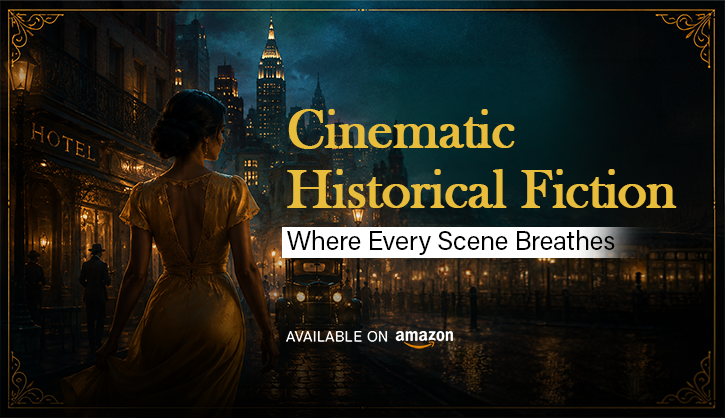
Not just to read a historical romance. But to live inside one. To feel the cold Atlantic spray on the deck of a ship arriving at Ellis Island in 1919. To hear the piano keys finding their tune in a Manhattan warehouse on a late spring morning. To stand in a ballroom full of silk and fedoras and flashbulbs and watch two people across a crowded room find each other at exactly the wrong moment.
That is what cinematic historical fiction means to me. And this is how I built it.
What Cinematic Historical Fiction Actually Means
The term gets used loosely. So let me tell you what it means inside this book specifically. Every chapter in Truth, Dreams, and The Everythings In-Between opens like a scene.
Not a chapter heading followed by a paragraph of description. A scene. With a specific location. A specific time of day. A specific emotional temperature that tells you exactly where you are before a single word of dialogue is spoken.
Some chapters open with a long shot. A wide view of a ship pulling into New York Harbor, the skyline rising out of the Atlantic like something that cannot possibly be real. Others open with a close-up. Pupils dilating. Big hazel eyes blinking slowly. The camera of the prose zooming in until you are looking at the world through Kavi’s eyes so directly that her anxiety becomes your anxiety, her wonder becomes your wonder.
There are music cues. Actual songs that anchor the emotional register of each scene. When Kavi and David sit together on the piano bench for the first time, the music that plays is not incidental. It is structural. It tells you what the words are not quite saying yet.
There are dream sequences that dissolve the boundary between memory and present moment, between what happened and what was always going to happen. And there are fade-outs at the
end of scenes that do what a good film cut does. They leave you in the feeling instead of explaining it.
This is cinematic historical fiction. Not a novel that describes a film. A novel that moves like one.
Why I Could Not Write It Any Other Way
My entire career before this book was visual.
Theatre. Independent film. Technology. Media production. I have spent decades learning how stories live in time and space, how an image carries emotion that words sometimes cannot reach, how the right piece of music at the right moment can make an audience feel something they did not know they were carrying.
When Truth, Dreams, and The Everythings In-Between arrived and demanded to be written, it arrived cinematically. There was no other option. The story already had a visual grammar. It already had a soundtrack. It already knew how it wanted to move.
Writing it felt less like putting words on a page and more like transcribing something that was already playing inside my head in full colour and sound.
I am a filmmaker who wrote a book. And the book knows it.
That is not a stylistic choice I made at a desk. It is simply the truest form I know for telling a story. When you have spent your life thinking in images, in scenes, in the weight of a well-placed silence, you bring all of that to the page with you. And sometimes, the page becomes a screen.
How the Setting Becomes a Character
One of the things cinematic historical fiction does that traditional historical fiction sometimes does not is treat the setting as an active participant in the story rather than a backdrop.
In Truth, Dreams, and The Everythings In-Between, 1919 New York is not the scenery. It is a force.
The cold concrete of Ellis Island presses down on Kavi the moment she steps off the ship. The polished floors of the piano warehouse catch the light in a way that makes the showroom feel like a stage. The Garment District Capitol Building during the political gala glitters so brightly that David feels like an impostor the moment he walks in.
The city has moods. It has sounds. The tarantella drifting out of a shop near the docks on David’s first night. The organised chaos of garment workers striking in the street outside the warehouse. The piano melody that keeps appearing at key moments like a theme song for something neither Kavi nor David has a name for yet.
When I write a scene, I am not describing a location. I am building a world that pushes back against the characters, that shapes their choices, that makes certain things possible and certain things impossible.
That is what 1919 New York does to Kavi and David. It gives them each other. And then it takes everything it can.
The Scene That Made Me Believe in This Book
There is a moment in Chapter Three where Kavi hears the piano playing in the warehouse below her desk for the first time.
She does not know who is playing. She does not know yet that it is David. She just hears the music, off-key at first, then steadily finding its shape, and something inside her responds to it the way she responds to very few things in her life. With complete, unguarded recognition.
She moves toward it. She leans over the railing. She looks down.
And it is him.
I wrote that scene and I knew. That is the moment this book became real to me. Not because of what happens between them at that piano bench. But because of the way the music arrived first. The way the story announced itself through sound before it announced itself through feeling.
That is cinematic historical fiction doing what it does best. Building the emotion in layers. Sound before image. Image before word. Word before meaning. And then meaning landing all at once, in a single moment, with the full weight of everything that came before it.
What This Means For You as a Reader
Reading Truth, Dreams, and The Everythings In-Between is not a passive experience.
You will not drift through it. You will be pulled through it, scene by scene, the way a film pulls you forward before you have decided whether you want to keep watching.
You will hear the music. You will feel the cold. You will stand in that ballroom in 1919 and feel exactly what is at stake between two people who were never supposed to meet. and you will understand, in the way that only cinematic historical fiction can make you understand, exactly what it costs two people to love each other in a world that was not built to hold them.
This book is for readers who want more than a story. It is for readers who want an experience.
If you love historical romance that immerses you completely, if you are drawn to cinematic storytelling that moves the way your favourite prestige television does, if you want to feel 1919 New York rather than simply read about it, this novelette was written for you.
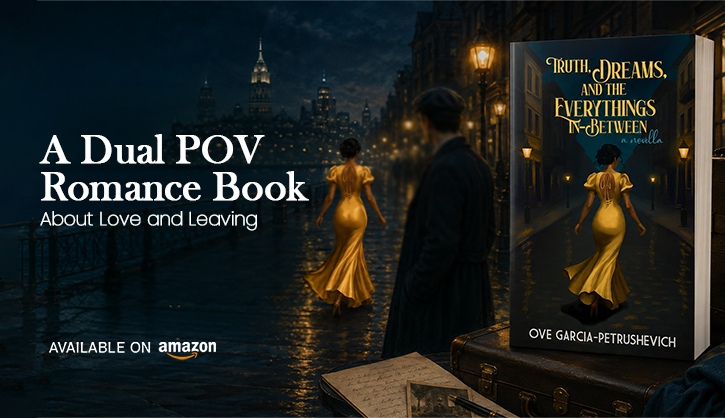
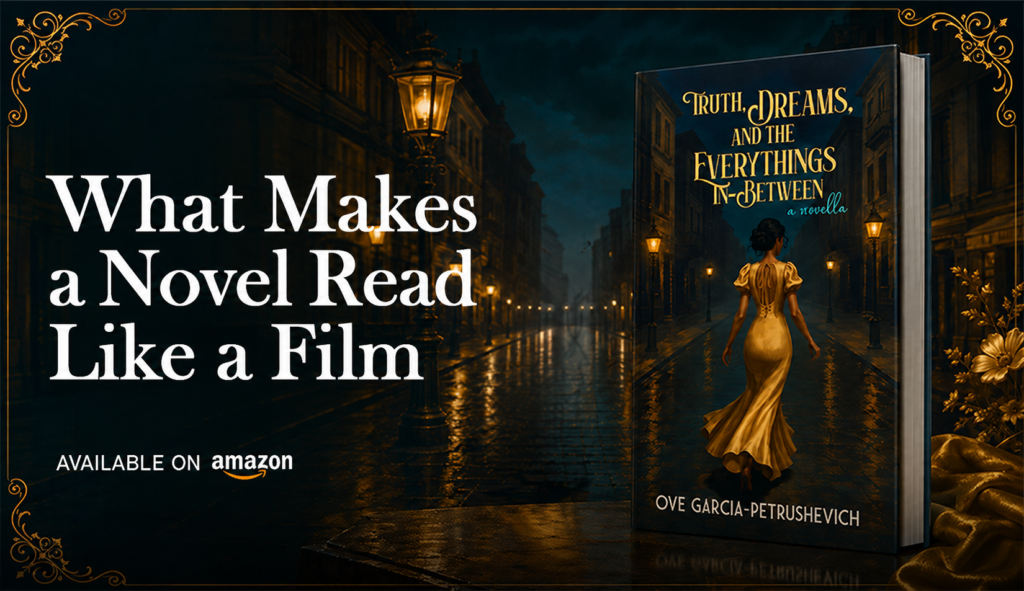
Truth, Dreams, and The Everythings In-Between is available now on Amazon in Kindle and hardcover editions.
Order your copy on Amazon and step inside the world of Kavi and David. You can also visit the Book Page to explore the full story, or the About Me page to learn more about the author and the creative world being built around it.
Frequently Asked Questions
Q1: What is cinematic historical fiction?
Cinematic historical fiction is a writing style where chapters are structured like film scenes, complete with visual direction, music cues, dream sequences, and emotional close-ups. It creates the immersive, sensory experience of watching a film while reading a book.
Q2: How is Truth, Dreams, and The Everythings In-Between cinematic?
Every chapter opens like a scene with a specific location, time, and emotional register. The book includes music cues, dream sequences, long shots, close-ups, and fade-outs that give the prose a visual and rhythmic quality closer to film than traditional fiction.
Q3: Why did Ove Garcia-Petrushevich choose a cinematic writing style?
Ovelinda’s background spans theatre, independent film, technology, and media production. Cinematic storytelling is the language she thinks in naturally. Writing Truth, Dreams, and The Everythings In-Between cinematically was not a stylistic experiment. It was simply the truest way she knows to tell a story.
Q4: Is cinematic historical fiction different from regular historical fiction?
Yes. Traditional historical fiction prioritises period accuracy and narrative description. Cinematic historical fiction uses the grammar of film, visual framing, music, pacing, and sensory layering, to make the historical world feel immediate, immersive, and emotionally alive rather than simply described.
Q5: Who is this book best for?
This book is best for readers who love historical romance, cinematic storytelling, dual POV narration, and emotionally layered immigrant stories set in early twentieth century New York.
Readers who enjoy prestige television with rich period atmosphere and complex characters will feel immediately at home.
Q6: Where can I buy Truth, Dreams, and The Everythings In-Between?
The novelette is available on Amazon in both Kindle and hardcover editions. You can find the direct purchase link on the Book Page of the official website.